|
What you want to know
these are a brief selection of questions we are asked and our responses.
Why choose a Nicolee Puppy?
NICOLEE is the result of over 30 years of selective breeding. A considerable amount of time and research has gone into refining my German Shepherd pedigree.
Suitability of the mating is paramount to insure we produce a top quality outstanding litter of healthy confident puppies in which to
further the breed.
Our puppies are whelped in a highly safe and clean enviroment and will be reared to a very high standard of care. They will be reared in our family home where they will grow and spend the first few vitally important weeks surrounded by all the hustle and bustle of everyday family life.
They will become accustomed to everyday noises, vacuuming, electrical machines and handled on a daily basis by my children and other adults.
They will be well socialised with adult's, children, our other dog's and will go out in our garden ( weather permitting ) and will be supervised at all times.
We will do our absolute best to insure that your puppy is confident, happy, and forward going. In an effort to make the transition from here to your home and family life as stress free as possible.
Prior to leaving, your puppy will be Kennel Club registered, undertaken a programme of worming, be microchipped, offered first vaccination, have a 5 generation pedigree, four week's Kennel Club Insurance, starter food pack and a comfort blanket.
All puppies will be fully vet checked and have an after sales contract providing you and your puppy with lifelong advice and support.
*PLEASE NOTE* in your puppy contract it will state that if for any reason at all you need to rehome your Nicolee puppy or dog, no matter what age he or she is, you must return him/her back here to us.
Your puppy will also have their kennel club paperwork endorsed:-
"x" Puppy is restricted from being exported
"R" Puppy is restricted from having it's progeny registered by the kennel club.
WE DO NOT, FOR ANY REASON, LIFT BREEDING RESTRICTIONS ON ANY OF OUR PUPPIES. SO PLEASE DO NOT ASK AS WE DO NOT WANT TO OFFEND.
THIS IS TO SAFE GUARD THE WELFARE AND FUTURE SAFETY OF ALL OUR PUPPIES FROM GETTING INTO THE WRONG HANDS.
When the time comes for your puppy to arrive into your family home it will become your responsibilty to provide him or her with a very happy and healthy fullfilling future. We advise you to socialise and educate your puppy as much as possible and to join a training class.
We hope you will have your new best friend for many many year's to come and we will always welcome you back into our home and look forward to recieving pictures and achievements that we can add to our website.
Back to Top
What should I feed my puppy on?
All Nicolee German Shepherd puppies are raised on Royal Canin or Purina Pro Plan with raw mince mixed in. We also include raw chicken wings on a daily basis. All puppies will leave here with a small bag to get you through approx a week or graduate the change onto your preferred food stuff.
If you are wanting to change your puppies diet please do this gradually over a a period of 1 week starting at day one with a couple of pieces of the new food in his regular meal.
Back to Top
What do I need to know about Inoculations, worming and flea treatment?
When a puppy is approximately 8 weeks old they should have their first inoculation for Distemper, Hepatitis, Parvo and Parainfluenza complex. When the puppy is approximately 12 weeks old the second inoculation is given. The puppy is not allowed out in the public until the inoculations are completed. After the second inoculation is given these then become annually. All puppies are wormed with Panacur Paste at 2,4,6 and 8 weeks of age. I worm my dogs every 3/4 months. Your vet will advise you on different types of dog wormer. Flea treatment can be given from 12 weeks of age. I advise Frontline.
Back to Top
Is my Puppy Vet Checked?
All Nicolee puppies are vet checked between 5 and 6 weeks of age and you will have proof of this in the puppy pack.
Back to Top
What do I need to know about Micro-chipping?
The microchip is inserted underneath the skin between the animal's shoulder blades, just below the base of the neck. This is done using a needle, and is similar to your dog having a routine vaccine jab at the vets.
The process should not cause your dog any more pain than a vaccine jab at the vets, and, when done properly, most animals don’t notice it’s happening, especially when distracted with a piece of food!
The microchip itself takes less than 2 seconds to insert. You will then be asked to fill out the registration form, which will take a further few minutes.
The microchip emits a radio wave that is detected by a hand held scanner (animal wardens, rescue centres, pounds, police, micro chippers and vets are all equipped with these scanners ). Should your dog go missing and get picked up by, or be taken to one of the above mentioned authorities, it will be scanned and the microchip detected.
The number on the microchip relates to your personal details which are held on a secure database e.g. Petlog® or Identichip® (The database will vary depending on the microchip manufacturer). The person detecting the chip will call the database to get your details and be able to inform you that your dog has been found.
A microchip is often compared to the size of a grain of rice. The microchip is approximately 11mm in length.
When your dog is micro chipped, you should be offered a collar tag, there may be an extra charge for this depending on the micro chipper and/or manufacturer. The writing on the tag usually that states that your pet is identified with a microchip, and often has the microchip database phone number. Please note - it is a legal requirement to have a tag on your dog with your name and address; your phone number is also a very good idea and the easiest way for a finder to contact you.
The microchip should last the life time of your pet. It is very rare for a microchip to stop working. For peace of mind ask your vet or local micro chipper to check your pets chip by scanning it every 6 months or so.
As I am a qualified Microchipper, all Nicolee puppies will be Microchipped before leaving.
Back to Top
When the puppies are born what age do you allow them to be seen by potential owners?
Our puppies can be visited from 4 weeks of age as we are conscious not to introduce any foreign object that could affect them at this vunerable age.
If you want to see the puppies earlier please contact us and we can forward pictures onto you. We will update our website with pictures of the puppies as they grow up.
Back to Top
Which Pet Insurance we recommend?
We recommend The Kennel Club endorsed 'Agria Pet' Insurance for its comprehensive cover and efficiency.
We have had horror stories relayed to us by other dog owners as a result of insuring a pet with companies that appear more affordable.
Back to Top
Should I take my puppy to training classes?
YES! Without question!
We advise you to do as much interaction with people,children and other dogs as possible. The puppies have been bought up around my family with two young children playing with them on a daily basis. They are introduced to household noises and taken out in the car for trips to get them used to traveling. We have cats, chickens ,geese and lots of horses here so they get used to a variety of animals before they go to their new home. Please check your area for dog training classes. Your vet may advise you of local classes.
Back to Top
What is Hip Dysplasia & Hip Scoring?
Hip dysplasia is a term which includes a number of specific developmental and other abnormalities involving the hip joint.
Hip dysplasia in Dogs
Hip dysplasia (HD) is a term which encompasses a number of specific developmental and other abnormalities involving the hip joint. Developmental changes come first and being related mainly to growth are known as primary changes. Others come later; these are related to wear and tear from usage and are termed secondary changes. The end result is that one or a pair of joints becomes mechanically unsound and therefore does not function properly An unsound joint is usually a painful one and lameness will result. In extreme cases the dog may find movement very difficult and much suffering will be involved.
It was in the light of these findings that the British Veterinary Association (BVA) and the Kennel Club (KC) developed a scheme some 30 years ago to assess the degree of hip malformation of dogs through radiography. Over this time almost 100,000 radiographs (X-rays) have been examined to provide a standardised pinion on HD status, principally for the use of breeders. Currently 97 breeds are surveyed by the scheme in the UK.
DEVELOPMENTAL DEMANDS
It is argued that dogs are not born with hips affected by dysplasia (unlike humans suffering from the disease). Hip modelling, otherwise termed development, can worsen with the passing of time, most particularly during the rapid growth phase between 14 and 26 weeks of age. Unwelcome
changes in anatomic relationships within the joint start in early puppyhood with first usage and continue through into young adulthood. Wear and tear from exercise of the distorted joint is followed by varying amounts of inflammation and degeneration resulting in remodeling change.
THE BVA/KC HD SCHEME
All radiographs submitted to the BVA/KC Hip Dysplasia Scheme are assessed by means of scoring. The hip score is the sum of the points awarded for each of nine radiographic features of both hip joints. The lower the score the less the degree of hip dysplasia present. The minimum (best) score for each hip is zero and the maximum (worst) is 53, giving a range for the total of 0 to 106 The average score of the breed, or the 'breed mean score', is calculated from all the scores recorded for a given breed and is shown alongside its range thereby giving a representation of the overall hip status of the breed. All breeders wishing to try to control HD should breed only from animals with hip scores well below the breed mean score.
For the hip scoring scheme to be meaningful and successful in the attempt to control this serious disease it is important that all radiographs taken under the scheme are submitted for scoring, whatever the apparent state of the hips, in order that the information gathered is as relevant as possible. It is only by this means that proper conclusions may be drawn by the scheme's statisticians, geneticists and veterinary advisers.
It is not hard to understand why things happen so quickly and how critical a whole series of factors in the dog's life are, when realising some animals treble their size and weight during a three- month period of adolescence. Getting all the many nutritional needs in the right quantity, to the right place and at the right time requires a mastery of logistics. However, it has to be realised that this apparent basic requirement overlays the parts played by inheritance and other factors, for example the type of exercise taken and the degree of body weight.
The only way to assess properly the presence or relative absence of HD is by radiography. This is an accurate photographic way of showing the position of the ball of the joint in relation to the socket and the presence and degree of any secondary changes.
CAUSES
If HD was caused by a single factor then it would have been fully under stood and largely overcome by now. It is known that two factors determine whether HD is to occur and, if so, how bad it will be - inheritance and what is termed 'environment'. The former relates to the genetic code passed to the offspring by both parents and the latter to all the outside influences which alter and mould the growth and functions of the bones, cartilage, ligaments, tendons and muscles of the body
In simplistic terms the genetic code is rather like the architect's building blue prints and, the environment, the builders and their materials. In HD the architect gets things wrong to a greater or lesser extent but the builders have the greater influence on how things look and function in the final analysis.
Back to Top
What is Elbow grading
Elbow dysplasia is a condition involving multiple developmental abnormalities of the elbow-joint. It is a common condition of certain breeds of dogs. Most developmental elbow abnormalities are related to osteochondrosis (OCD), which is a disease of the joint cartilage. Osteochondritis dissecans refers to separation of a flap of cartilage on the joint surface. Other common causes of elbow dysplasia included ununited anconeal process (UAP) and fractured medial coronoid process (FMCP).
Causes
In OCD, the normal change of cartilage to bone in the development of the joint fails or is delayed. The cartilage continues to grow and may split or become necrotic. The cause is uncertain, but possibly includes genetics, trauma, and nutrition (including excessive calcium and decreased Vitamin C intake).
The disease
OCD lesions are found in the elbow at the medial epicondyle of the humerus. Specific conditions related to OCD include fragmentation of the medial coronoid process of the ulna (FMCP) and an ununited anconeal process of the ulna (UAP). All types of OCD of the elbow are most typically found in large breed dogs, with symptoms starting between the ages of 4 to 8 months. Males are affected twice as often as females. The disease often affects both elbows (30 to 70 percent of the time), and symptoms include intermittent lameness, joint swelling, and external rotation and abduction of the paw. Osteoarthritis will develop later in most cases.
UAP is caused by a separation from the ulna of the ossification centre of the anconeal process. FMCP is caused by a failure of the coronoid process to unite with the ulna. OCD of the medial epicondyle of the humerus is caused by disturbed endochondral fusion of the epiphysis of the medial epicondyle with the distal end of the humerus, which may in turn be caused by avulsion of the epiphysis.
DIAGNOSIS
Diagnosis is through x-rays.
Back to Top
What is Haemophilia
Haemophilia ‘A’ is a bleeding disorder. Clinically, it is exactly the same in the GSD as it is in humans. The disease has been known to man as an inheritable problem since the 2nd century!
This contains an important message – it is normally only MALES that are afflicted. Whilst it is possible for a female to have the disorder it is EXTREMELY rare. The mode of inheritance is shown below… because the disease is sex-linked then it is only necessary to look at the sex-chromosomes X and Y to understand how it is passed on. It is, in fact, a problem with the ‘female’ X chromosome and in the diagram below, the affected or abnormal gene is represented by Xh. The diagram shows all the possible combinations from the first generation of breeding using a male haemophiliac…
"Starting with an affected Male - by inheritance or mutation"
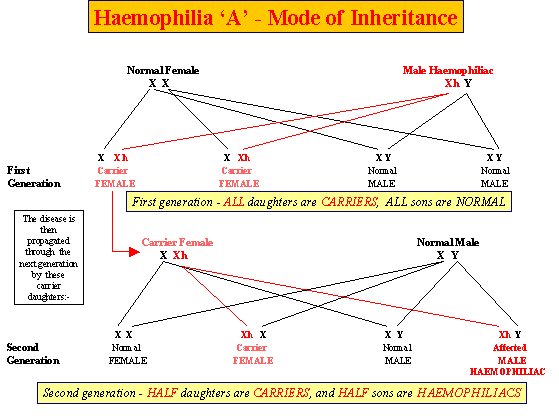
So for a female to be affected, the disease would require TWO abnormal X chromosomes to come together – as mentioned before not a likely event.
However, history has taught the dangers of not testing males before using them at stud to be certain that they do not have this disorder. The problem is that by the time we find out about them from the offspring they produce (and from the diagram above you can see that we will not learn of this until the second generation!), the number of affected males and carrier females can be very large. Consequently, it is easy for the disease to spread quickly with the resulting nightmare of people who have bought puppies for pets having to live with a continual risk of there dog possibly bleeding to death if they have even a minor injury. Some simply bleed to death from nothing more than a bump or knock.
Therefore, in August 1991 in the U.K. , the GSD Breed Council of Great Britain set up it’s own Haemophilia ‘A’ screening programme. It was largely due to the furore at that time surrounding a male GSD which had been imported from Germany and was a popular stud. Unfortunately he had sired around 80 litters of puppies before it was discovered that he was a Haemophiliac! We never want to see anything like this again. The scheme was designed and set up by John Allinson – a GSD breeder – who also just happens to have spent over 20 years in a career within analytical pathology. All tests are fully controlled and logged on to a database which is registered with the Data protection Registrar.
Since that time, it has become the norm amongst reputable GSD breeders to ensure any male they use at stud has been tested and proven clear of the disease. The test is performed on a small blood sample collected by your vet.
Pedigree positions (shaded areas) where known Haemophiliacs can pass the disease on to the dog to which the pedigree belongs.
Parents Grandparents GG Parents GGG Parents GGGG Parents
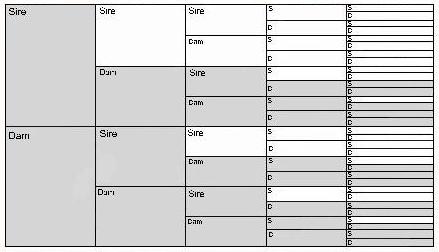
Males - only the BOTTOM half of this pedigree applies
Females - ALL the pedigree applies
Once a test is performed and is normal, it lasts for life! Breeders can also pass on proof of testing to new puppy owners.
Since the scheme started, previously unknown haemophiliacs and carrier females have been identified in the U.K.
The cost of medical procedures change over time, so please confirm charges with your vet.
Back to Top
What is DNA Profiling and what are the benefits?
Identification
The DNA profile is the ultimate in individual identification and offers a 'tamper-proof' means of identity. The profile need only be produced once and the DNA sample used to produce it can be stored as a permanent DNA record throughout the dog's life. Identification could be essential in a number of instances. For example, the availability of a profile could be used to identify an animal that may have been lost or stolen, and subsequently recovered. The profile could also be used to check the authenticity of a DNA sample being used to screen for the presence of disease-causing genes. Many such tests are being developed and it would be invaluable to be able to verify that the correct dog's DNA is being tested for the presence of the deleterious gene. Repeating the DNA profile on the same sample of DNA being used to carry out the gene test would be straightforward and prove conclusively that the correct animal is being tested.
Benefits of DNA Testing
DNA profiling provides an owner with their dog’s unique DNA identity.
DNA profiling establishes an accurate and reliable permanent record of any identity for any dog.
It confirms that pedigrees are correct and guarantees puppy buyers that pedigrees are accurate.
It can be used in cases of multiple sires and can determine and verify the sire in any litter.
It can verify parentage when using a stud service thus eliminating the doubt, which surrounds unobserved stud services.
It can verify and guarantee semen to be used for artificial insemination.
It can put to rest any issues of breeding disputes over parentage.
Hereditary disease tests allow for accurate diagnosis of disease status of your dog (clear, carrier or affected).
The Proof of the Puppy is in its Profile
A more detailed explanation of the process of DNA profiling - by Dr Jeff Sampson.
Buried within the DNA of each and every individual is a special DNA signature that can be used to uniquely identify that individual. DNA profiling is the name given to the technique that has been developed to reveal this DNA signature. Initially, DNA-based approaches to identifying individuals were pioneered in humans, but the same technology has easily been transposed to the dog. Nowadays, special sequences found in DNA called micro satellites are used to build up this DNA signature. Micro satellites have become the system of choice for DNA profiling and genetic testing in humans. The US Armed Forces, FBI, Scotland Yard, The Royal Canadian Mounted Police and multiple forensic laboratories use micro satellites for their forensic, paternity and individual identification tests. The reasons that have made them come to the fore in humans are the very reasons that currently make them the system of choice for dogs.
The technique essentially involves preparing a DNA sample from an individual dog. For this we need to obtain some tissue from the dog in order to prepare the DNA. The ideal source of material would be a blood sample which will permit us to isolate DNA from the white cells; this however requires a vet to take the sample of blood before passing it onto the laboratory for testing. Less invasive techniques which don't require veterinary intervention have therefore been sought to make the procedure more convenient. One alternative source of tissue are the cells that can be easily removed from the inside of a dog's cheek, called buccal cells.
In this case all that is required is to gently rub a small plastic brush against the inside of the cheek to remove the buccal cells. The brush, containing the cells can then be returned to the laboratory for analysis. DNA can be made from both tissue sources, although considerably less DNA is provided by the buccal cells because they are considerably fewer in number.
What can DNA profiling offer? Well, as I have explained, the DNA signature that is revealed can uniquely identify an individual dog. However, the profile is not just a means of identification because it also carries within it information on the parents of the dog. This is because a puppy inherits half of its DNA from its mother and the remaining half from its father. This essentially means that half of the components that make up the profile are maternal in origin and the other half paternal. So it is in these two areas that profiling has impact: individual identification and parentage verification.
Back to Top
What do I do if my GSD puppies ear or ears have not come up
If your puppy is over 4 months old are worried that your German Shepherd puppies ears have not come up then please contact me. I can help.
Do not panic if they have come up and gone back down again they will do this over the first 7-9 months.
Occasionally a German Shepherd puppy will need some help in getting his/her ears to stand up. AND if other dogs at home are not biting the pups ears ....99.9 % of the time the ears will go up
We always advise people not to let their puppy play unsupervised with other dogs and puppies while the ears are going up - as when dogs play they will bite heads, necks, and ears! That could damage the ears causing them not to go up.
We advise people to give their puppy something to chew on to encourage the ears to come up. We recommend Rawhide bones,pigs ears and fresh raw beef bones.
Back to Top
What is Poisonous to dogs and Puppies
Chocolate
|
Symptoms: Vomiting, diarrhoea, increased heart rate, rapid breathing, muscle tremors, seizures and coma.
It often surprises pet owners to discover that the drugs in chocolate is poisonous in sufficient dosages, particularly to dogs. Specifically it is the drugs Theo bromine and caffeine (of the drug class methylxanthines), that are toxic to pets. Only a moderate amount needs to be eaten by a dog, in order to be poisonous (approx. ½oz. of baking chocolate per pound of body weight and less in some animals).
It is also believed that dark or plain chocolate is more toxic than the milk or cooking chocolate variety. |
| Grapes |
Grapes and all grape products are being considered poisonous to dogs by some international Animal Authorities |
| Nutmeg |
Symptoms: Hallucinogen. |
| Onions |
Symptoms: Cause anaemia
Onions should not be fed to dogs in any form. |
| Voltarin |
Symptoms: This drug is used in rheumatoid arthritis. It is a slow release drug that acts over 3/4 days, causing massive internal bleeding in dogs. An anti-toxin and stomach flush must be used immediately by a vet in order to prevent permanent damage to internal organs.
Can be Fatal
|
Plants
| Extremely
Toxic |
Moderately
Toxic |
Minimally
Toxic |
|
NAME |
TOXIC
PARTS |
SYMPTOMS |
|
Aconite |
All |
Nausea and vomiting |
|
Aloe Vera |
. |
Diarrhoea |
Alsike
Clover
trifolium hybridum |
whole plant
generally affects horse, cattle and sheep
|
causes
female organs to swell
starts milk production without pregnancy, cause temporary or permanent
infertility |
|
Amaryllis |
Bulbs |
Upset Stomach, Hyperactivity Lethargy Coma, Shock |
|
Angels' trumpets |
Toxic if eaten |
nausea and vomiting |
Apple
seeds &
Apple pips |
seeds |
Varied Toxic Effects. The plant is
cyanogenic |
|
Apple leaf croton |
Whole
plant very toxic
|
Could
be fatal – due to ricin – hemorrhages of the heart, degradation of
the kidneys and liver and intense inflammation and erosion of intestinal
membranes |
|
Apricot
Kernel |
Kernels contain cyanide. |
Children have died from eating too many kernels! |
|
Arborvitae |
Harmful if eaten in quantity |
May cause a skin allergy |
|
Asparagus fern |
. |
Contains a wide variety of poisons resulting in a
bewildering range of symptoms. |
|
Autumn crocus |
bulbs and entire plant |
vomiting, nervous
excitement. Plant can cause dermatitis |
|
Avocado |
fruit and
pith |
diarrhoea,
vomiting, laboured breathing, |
|
Azalea |
entire
plant |
nausea, vomiting,
depression, difficulty breathing and coma |
|
Barilla |
leaves and stems
|
plant contains soluble oxalates |
Benweed
Senecio jacobaea |
See Ragwort |
See Ragwort |
|
Bird of paradise |
seeds |
gastrointestinal tract affected by the plant toxins |
|
Bittersweet |
Entire plant |
The plant is reputed to be toxic |
Black
Locust
Robinia
pseudoacacia |
All parts of the tree, except the flowers – the
bark is considered the most toxic |
staggering,
paralysis, - mainly affecting horses, cattle sheep and poultry |
|
Black
Walnut |
entire |
Harmful if eaten in quantity.
Can cause temporary paralysis |
Bleeding
Heart
dicentra spectabilis |
foliage,
roots, |
Poisonous
in large amounts, contains convulsant including isoquinoline. Plant also
causes dermatitis |
|
Blue bell |
. |
Harmful if eaten in quantity |
|
Boxwood |
entire
plant |
Upset Stomach, Heart
Failure, Excitability or Lethargy. Plant also causes dermatitis |
|
Branching ivy |
berries and leaves |
gastrointestinal tract affected by saponins. Plant also causes dermatitis |
British
Manrake
bryonia
dioica |
See
White
Bryony |
See
White
Bryony |
Buckeyes
Aesculus hippocastanum |
Nuts, immature growths |
Gastrointestinal tract affected by saponins |
|
Buckthorn |
. |
Harmful if eaten in quantity |
|
Burning Bush |
Toxic if eaten |
Nausea and vomiting. May cause a skin allergy. |
Buttercup
Ranunculus
spp. |
entire
plant |
juice may severely injure
digestive system. Plant also causes dermatitis |
|
Caladium |
. |
Upset Stomach, Oral
Irritation, Asphyxiation, Tremors, Seizures, Loss of Balance |
|
Calico Bush |
Toxic if eaten |
Nausea and vomiting. May cause a skin allergy. |
|
Calla lily |
Leaves |
Upset Stomach, Oral
Irritation, Asphyxiation, Tremors, Seizures, Loss of Balance |
Cannabis
cannabis sativa |
the
whole plant – in all forms - it
has a bitter taste and so generally
avoided by animals |
muscular
weakness,
salivation, vomiting, drowsiness – not generally fatal |
|
Castor bean
Ricinus communis L. |
Entire
Plant
Highly
toxic seeds contain toxalbumins. |
A single Rosary Pea or one to two Castor Bean seeds can cause death. Plant also causes dermatitis |
|
Charming dieffenbachia |
mainly
from the sap or the water that cutting were in |
Repeated
vomiting and diarrhoea – recover after three days- |
|
Cherry |
Kernels |
plant is
cyanogenic |
|
Cherry Laurel |
.
|
Harmful if eaten in quantity |
Chinese
Lantern
Solanum spp |
See
Nightshade |
See
Nightshade |
Christmas
Cherry
Solanum spp |
See
Nightshade |
See
Nightshade |
|
Christmas rose |
entire plant |
Upset Stomach, Diarrhoea,
Seizures, Disorientation. Cardiovascular system affected by the cardiac glycosides helleborin and helleborein. Plant also causes dermatitis |
|
Chrysanthemum |
Leaves and stems |
May cause a
rash after contact. May cause dermatitis |
|
Clematis |
Entire plant |
gastrointestinal tract and nervous system affected by plant toxins. Plant also causes dermatitis |
Cocklebur
Xanthium strumarium |
. |
. |
|
Colombine |
. |
Harmful if eaten in quantity |
Common
Nettle
urtica dioica |
See
Stinging Nettle |
See
Stinging nettle |
Common
St. Johns Wort
hypericum perforatum |
See
St. Johns Wort |
See
St Johns Wort |
Common
Stonecrop
sedum acre |
the
whole plant |
if
eaten in large quantities – salivation, muscle tremors, rapid
respiration and coma |
|
Cordatum |
. |
. |
|
Corn cockle |
. |
Harmful if eaten in quantity |
|
Cuckoo pint |
. |
Nausea and vomiting. May cause a skin allergy. |
|
Cutleaf philodendron |
The whole plant |
causes diarrhoea upon ingestion. Also causes dermatitis when touched. Causes burning sensation in mouth when eaten |
|
Cyclamen |
Flowers |
induced vomiting – skin reaction |
|
Daffodil
1 Narcissus spp. |
bulbs |
nausea, vomiting, diarrhoea caused by the alkaloid toxins. Plant also causes dermatitis |
|
Daphne |
berries and seeds, but also entire plant |
gastrointestinal tract and kidneys affected by coumarin glycosides. Plant also causes dermatitis |
|
Dwarf
Bay |
See
Mezereon |
See
Mezereon |
Deadly Nightshade
Solanum spp |
See
Nightshade |
See
Nightshade |
Delphinium
Delphinium spp. |
. |
Harmful if eaten in quantity |
|
Dendrathema |
. |
May cause a skin
allergy |
|
Devils
figs |
. |
Harmful if eaten in quantity |
Devil's Ivy
(Philodendron) |
The whole plant |
causes diarrhoea upon ingestion. Also causes dermatitis when touched. Causes burning sensation in mouth when eat. Upset Stomach, Mouth
Irritation, Tremors, Seizures, Loss of Balance, asphyxiation, death |
|
Dracaena palm |
. |
. |
Dumb cane
dieffenbachia |
. |
Upset Stomach, Oral
Irritation, Asphyxiation, Tremors, Seizures, Loss of Balance, Death |
Dutchman
Breechs
Dicentra spp |
See
Bleeding Heart |
See
Bleeding Heart |
|
Dwarf Morning glory |
. |
Harmful if eaten in quantity |
|
Easter lily |
. |
(especially poisonous to cats) |
|
Echium |
. |
May cause a skin allergy |
Elderberry
Sambucus canadensis
L. |
shoots,
bark, and leaves. Entire plant. |
nausea and vomiting. Plant is
cyanogenic and may contain toxic levels of nitrates. |
|
Elephant ears |
all parts |
intense burning, irritation
and swelling of the mouth and throat. Death can occur is tongue swells
enough to block air passage |
|
English ivy
Hedera helix L. |
berries and leaves |
gastrointestinal tract affected by saponins. Plant also causes dermatitis |
Ergot
Claviceps
purpurea |
. |
Causes
abortions in humans and sheep - suggestions it would do the same in
dogs. |
|
European spindle |
. |
Harmful if eaten in quantity |
|
Exotica perfection
dieffenbachia |
mainly
from the sap or the water that cutting were in |
Repeated
vomiting and diarrhoea – recover after three days |
False
Acacia
Robinia
pseudoacacia |
See
Black Locust |
See
Black Locust |
|
False Hellebore |
. |
Nausea and vomiting. |
Fescue
Festuca
arundinaceae |
. |
. |
|
Flannel flower |
. |
Harmful if eaten in quantity |
|
Flax |
. |
Harmful if eaten in quantity |
Foxglove
Digitalis purpurea L. |
Entire plant |
cardiovascular system affected by the glycosides digitalin and digitoxin. Gastrointestinal tract affected by saponins |
|
Fruit salad plant
(philodendron) |
The whole plant |
causes diarrhoea upon ingestion. Also causes dermatitis when touched. Causes burning sensation in mouth when eaten |
|
Gaultheria |
. |
Harmful if eaten in quantity |
|
Geranium |
. |
Mild
dermatitis |
|
German ivy |
berries and leaves |
gastrointestinal tract affected by saponins. Plant also causes dermatitis |
|
German primula |
. |
Nausea and vomiting. May cause a skin allergy. |
|
Giant dumb cane |
mainly
from the sap or the water that cutting were in |
Repeated
vomiting and diarrhoea – recover after three days- |
|
Glacier ivy |
berries and leaves |
gastrointestinal tract affected by saponins. Plant also causes dermatitis |
|
Glory Lily |
. |
causing nausea and vomiting |
|
Gold dieffenbachia |
mainly
from the sap or the water that cutting were in |
Repeated
vomiting and diarrhoea – recover after three days |
|
Golden chain tree |
entire plant especially bean-like capsules in which seeds are suspended |
excitement, staggering,
convulsions and coma. Nervous system affected by the alkaloid cytisine |
|
Granny's bonnets |
. |
Harmful if eaten in quantity |
Greater
Burdock
Arctium lappa |
burs
|
Symptoms
burs to coats of dogs cause skin irritation – dogs remove burrs by
licking – hooked scales penetrate the mucous membrane of mouth and
tongue – ulceration, oral discomfort, salivation |
|
Hahn’s self-branching
English ivy |
berries and leaves |
gastrointestinal tract affected by saponins. Plant also causes dermatitis |
|
Heartleaf philodendron |
The whole plant |
causes diarrhoea upon ingestion. Also causes dermatitis when touched. Causes burning sensation in mouth when eaten |
Hemp
Cannabis sativa L. |
See
Cannabis |
See
Cannabis |
|
Henbane |
Toxic if eaten |
Nausea and vomiting. |
|
Holly |
Berries |
Upset Stomach, Tremors,
Seizures, Loss of Balance |
Honeysuckle
lonicera periclymenum |
plants
and berries |
vomiting,
diarrhoea and lethargy |
Horse
tail
Equisetaceace |
the complete weed 7 |
mainly affects horses and to a lesser
cattle |
Horse chestnut
Aesculus hippocastanum |
' |
Harmful if eaten in quantity |
|
Horse
head philodendron |
The whole plant |
causes diarrhoea upon ingestion. Also causes dermatitis when touched. Causes burning sensation in mouth when eaten |
|
Hurricane plant |
bulb |
Varied Toxic Effects |
Hyacinth
Hyacinth orientalis |
bulb |
gastrointestinal tract affected by alkaloid toxins, Plant also causes dermatitis |
|
Indian rubber plant |
. |
. |
|
Iris |
tubers |
severe digestive upset. gastrointestinal tract affected by the glycoside
iridin. plant also causes dermatitis |
Ivy
araliaceae |
whole plant |
vomiting, diarrhoea,
excitement, muscular spasms, paralysis
|
Jack in the Pulpit
Arisaema spp. |
entire
plant |
contains small crystals of
calcium oxalate, causes burning to the mouth, can cause hallucinations |
|
Japanese show lily |
. |
especially poisonous to cats |
|
Japanese Spindle |
. |
Harmful if eaten in quantity |
| 8 Jessamine |
berries and sap |
Digestive disturbance. gastrointestinal tract affected by solanine
glycoalkaloids. The nervous system affected by atropine-like toxins |
Jerusalem cherry
Solanum pseudocapsicum
|
immature growths. |
gastrointestinal tract affected by solanine
glycoalkaloids. may contain toxic levels of nitrates. plant may also cause dermatitis |
Jimson Weed
Datura stramonium L. |
entire
plant |
abnormal thirst, distorted
sight, delirium, incoherence, coma caused by the alkaloids atropine, scopolamine and
hyoscyamine. May contain toxic levels of nitrates. |
|
Johnsongrass |
. |
. |
|
Kingcup |
. |
Harmful if eaten in quantity |
|
Lacy tree philodendron |
The whole plant |
causes diarrhoea upon ingestion. Also causes dermatitis when touched. Causes burning sensation in mouth when eaten |
|
Larkspur |
young
plants and seeds |
digestive upset,
nervousness, depression. Cardiovascular system affected by alkaloids including delphinine. Plant also causes dermatitis |
Latana
Lantana camara L. |
green
berries (immature) |
affects
lungs, heart, kidneys and nervous system, affected by lantodene, an atropine-like toxin. Plant is also hepatogenic |
|
Laurel |
. |
Harmful if eaten in quantity |
|
Lenton rose |
. |
Harmful if eaten in quantity |
|
Leopard lily |
. |
Nausea and vomiting. May cause a skin allergy. |
|
Leyland cypress |
. |
May cause a skin allergy |
Lily of the valley
Convallaria majalis |
entire plant
|
irregular
heart beat and pulse accompanied by digestive upset and mental confusion caused by the glycosides convallarin and convallamarin |
|
Lobelia tupa |
. |
May cause a skin allergy |
|
Locust |
bark,
sprouts, foliage |
nausea and weakness |
Lupine
Lupinus spp |
. |
. |
|
Mallow |
. |
Harmful if eaten in quantity |
|
Marsh Marigold |
. |
Harmful if eaten in quantity |
|
Marble queen |
. |
. |
|
Marijuana |
leaves and flower bracts |
plant contains the hallucinogens tetrahydro-cannabinols |
May apple
Podophyllum peltatum L. |
apple,
roots, foliage |
severe diarrhoea. Contains 16
active toxic agents, mainly in the roots. Nervous system affected by plant toxins, also causes hematological abnormalities. Powdered root may cause conjunctivitis and keratitis |
|
Meadow rue |
. |
Harmful if eaten in quantity |
|
Meadow Saffron |
. |
nausea and vomiting |
| Mexican breadfruit |
(split leaf philodendron) |
. |
|
Mezereon |
. |
could
prove fatal – lethargy dizziness vomiting diarrhoea |
Milkweed
Asclepias syriaca L. |
. |
May cause a skin allergy |
|
Mistletoe |
berries, leaves and stems. |
gastrointestinal tract affected by toxalbumins. Plant may also cause dermatitis.
If ingested a few berries can be fatal to a puppy |
|
Monkshood |
entire plant especially fleshy
roots |
digestive upset and
nervous excitement. cardiovascular system affected by alkaloid toxins |
|
Moonseed |
Berries
resembles wild grapes, contains a single seed |
contains
convulsant |
|
Morning glory |
, |
Upset Stomach, Hallucinations |
|
Moroccan broom |
. |
Harmful if eaten in quantity |
|
Mountain laurel |
. |
Harmful if eaten in quantity |
|
Naked
Lady Lilly |
See
Amaryllis |
See
Amaryllis |
Narissus
Narcissus spp. |
bulbs |
nausea, vomiting,
diarrhoea caused by the alkaloid toxins. Plant also causes dermatitis |
|
Needlepoint ivy |
berries and leaves |
gastrointestinal tract affected by saponins. Plant also causes dermatitis |
|
Nightshade
Solanum spp. |
entire
plant |
intense digestive
disturbances |
|
Oak tree |
Foliage
and Acorns
Also the bark of the tree. |
Poisoning by oak is usually seasonal, being most common in spring when the
young buds or leaves are eaten and the autumn when the acorns are eaten. Oak
leaves and acorns contain tannic acid which is poisonous to horses and
though eating a small number of leaves or acorns is almost certainly
harmless, they can also be addictive, and once a horse has acquired a taste
for them they can actively search them out. Also some animals seem to be
more susceptible to oak poisoning than others with individual animals having
different levels of tolerance.
Oak poisoning causes gastroenteritis and kidney damage.
Symptoms include: lack of appetite, staring coat, constipation followed by
diarrhoea which may be bloodstained, abdominal pain
depression, blood in urine
There is no antidote. The horse is treated with drugs to reduce the pain and
control the diarrhoea, antibiotics may be prescribed. |
|
Oleander
Nerium oleander L. |
leaves and
branches. Entire plant and the water used for cut plants. |
affects the heart, produces
severe digestive upset. Extremely poisonous, can cause death. cardiovascular system affected by the glycosides
oleandrin, oleandroside and nerioside. Plant may also cause dermatitis |
|
Onion |
Onions should not be fed to dogs in any form. |
Cause
anemia. Sometimes Urine becomes red – enlarged kidneys degeneration
of liver |
|
Oriental lily |
. |
(especially poisonous to cats) |
Ornamental Pepper
Solanum spp |
See
Nightshade |
See
Nightshade |
|
Paspalum |
Sticky material from seeds |
dermatitis |
|
Pasque flower |
. |
Harmful if eaten in quantity |
|
Peace lily |
entire plant |
gastrointestinal tract affected by plant toxins. Plant also causes dermatitis |
|
Peach |
Both the stone and leaf contain cyanide |
Plant is
cyanogenic |
|
Pencil cactus |
. |
similar
to LSD – hallucinogenic |
|
Peruvian lily |
. |
May cause a skin allergy |
|
Pineapple broom |
. |
Harmful if eaten in quantity. |
Poison Hemlock
Conium maculatum L. |
entire
plant
(resembles a wild carrot) |
nervous system affected by alkaloids including coniine, conidrine and coniceine. May contain toxic levels of nitrates. Plant also causes dermatitis |
|
Poinsettia |
leaves stems and sap |
Diarrhoea,
abdominal cramps, delirium. Sap can cause irritation, and if rubbed in
eyes - BLINDNESS. gastrointestinal tract affected by the toxin euphorbin, may contain toxic levels of nitrates. Plant also causes dermatitis |
|
Poison ivy
Toxicodendron radicans (L.) Kuntze |
Leaves, bark and fruit contain a
variety of poisons. |
may cause dermatitis |
|
Poison oak |
Leaves, bark and fruit contain a
variety of poisons. |
may cause dermatitis |
|
Poison sumac |
4 . |
Can cause severe blistering dermatitis if they come into contact with skin. |
|
Poisonous Primula |
Toxic if eaten |
Nausea and vomiting. May cause a skin allergy |
|
Pokeroot |
Toxic if eaten, |
causing vomiting and nausea |
|
Pokeweed |
Toxic if eaten. |
Nausea and vomiting |
|
Poppy |
. |
Harmful if eaten in quantity |
|
Pothos |
The whole plant |
causes diarrhoea upon ingestion. Also causes dermatitis when touched. Causes burning sensation in mouth when eaten |
|
Precatory bean |
seeds |
gastrointestinal tract affected by toxalbumins |
|
Primrose (primula) |
leaves |
Upset
Stomach and may cause dermatitis |
|
Ragwort
Senecio jacobaea |
Entire
plant
A common yellow flowered weed found in rough pasture and in some lawns. It is highly toxic to a wide variety of animals, especially horses and cattle, usually digested when dead as it becomes more palatable. However a number of dogs die by eating a small amount whilst grazing on long grass. If you ensure that your lawns etc are kept free of the weed, and keep a check on dog grazing, the plant is
obvious so it can be done easily.. |
Causes kidney failure and liver damage and is irreversible. Minute doses fatal, often wrongly diagnosed. Pyrrolizidine alkaloids cause hepatic
veno-occlusive disease (Budd-Chiari syndrome) in humans
Note: In UK this plant is notifiable to
MAFF due to its toxicity to livestock. If you have it on your land, please dig it up and dispose of it by burning. Do not leave it lying around as its toxicity increases. It must be dug up as the seeds can stay in the ground for a number of years.
|
Red
Clover
trifolium pratense) |
See
Alsike Clover |
See
Alsike clover
Infertile problem with cattle |
|
Red-ink plant |
. |
nausea and vomiting |
|
Red
Maple |
. |
. |
Rhododendron
Rhododendron spp. |
entire
plant |
nausea, vomiting,
depression, difficulty breathing and coma |
Rhubarb
Rheum
Rhabarbarum |
leaves |
large amounts of raw or
cooked leaves can cause convulsions, coma and in extreme cases, death |
Rosary
Pea
Ricinus communis L. |
See
Castor Bean |
See
Caster Bean |
|
Rosebay |
. |
nausea and vomiting |
|
Rose periwinkle |
. |
Harmful if eaten in quantity |
|
Rue |
5 . |
nausea and vomiting. May cause a skin allergy |
|
Saddle leaf philodendron |
The whole plant |
causes diarrhoea upon ingestion. Also causes dermatitis when touched. Causes burning sensation in mouth when eaten |
|
Satin pothos |
The whole plant |
causes diarrhoea upon ingestion. Also causes dermatitis when touched. Causes burning sensation in mouth when eaten |
|
Savin |
. |
Harmful if eaten in quantity |
|
Schefflera |
. |
nausea and vomiting. May cause a skin allergy |
|
Senecio |
. |
. |
|
Silkweed |
. |
Harmful if eaten in quantity |
|
Silver pothos |
The whole plant |
causes diarrhoea upon ingestion. Also causes dermatitis when touched. Causes burning sensation in mouth when eaten |
|
Solomon
seal |
. |
Harmful if eaten in quantity |
| 0 Spotted dumb cane |
mainly
from the sap or the water that cutting were in |
Repeated
vomiting and diarrhoea – recover after three days |
|
Spurge
Flax |
See
Mezereon |
See
Mezereon |
| Spurge
Olive |
See
Mezereon |
See
Mezereon |
|
Spurge Laurel |
. |
nausea and vomiting. May cause a skin allergy |
|
Squill |
. |
Harmful if eaten in quantity |
Staggerweed
Senecio jacobaea |
See
Ragwort |
See
Ragwort |
|
Star of Bethlehem |
. |
Harmful if eaten in quantity |
|
Starflower |
. |
Harmful if eaten in quantity |
Stinging
nettle
urtica dioica |
stinging
hairs release active irritant substances into skin |
in
very extreme
cases – trembling, vomiting, difficulty in breathing and weakness |
St
James Wort
Senecio jacobaea |
See
Ragwort |
See
Ragwort |
St
Johns Wort
hypericum perforatum |
Complete
plant
|
Symptom lesions develop on
un- pigmented areas of skin exposed to sunlight - photosensitization |
Subterranean
Clover
trifolium subterranium |
See
Alsike Clover |
See
Alsike Clover |
|
Sweetheart ivy |
berries and leaves |
gastrointestinal tract affected by saponins. Plant also causes dermatitis |
|
Swiss cheese plant |
mainly
from the sap or the water that cutting were in |
Repeated vomiting and diarrhoea – recover after three days- but not so severe |
Tansy
Senecio jacobaea |
See
Ragwort |
See
Ragwort |
|
Taro vine |
The whole plant |
causes diarrhoea upon ingestion. Also causes dermatitis when touched. Causes burning sensation in mouth irritated by plant raphides |
|
Thorn
Apple |
See
Jimson weed |
See
Jimson weed |
|
Tiger lily |
. |
(especially poisonous to cats) |
|
Tomato plant |
green fruit, stem, and leaves |
. |
|
Tree philodendron |
The whole plant |
causes diarrhoea upon ingestion. Also causes dermatitis when touched. Causes burning sensation in mouth when eaten |
|
Tropic snow dieffenbachia |
mainly
from the sap or the water that cutting were in |
Repeated vomiting and diarrhoea – recover after three days- |
Tulip
Tulipa spp |
. |
May cause a skin allergy |
|
Variegated philodendron |
The whole plant |
causes diarrhoea upon ingestion. Also causes dermatitis when touched. Causes burning sensation in mouth when eaten |
|
Variegated rubber plant |
4 . |
. |
|
Varnish tree |
. |
Poisonous. Can cause severe blistering dermatitis if they come into contact with skin. |
Water Hemlock
Cicuta maculata |
entire
plant especially the roots |
4 violent painful convulsions,
death caused by the convulsant cicutoxin |
White
Bryony
bryonia dioica |
mainly
the roots – worse toxic when dried |
possible increase in body temp rapid respiratory and heart rates |
White
Clover
trifolium repens |
See
Alsike Clover |
See
Alsike Clover
can suffer cyanide poisoning
|
|
Wild Cherry tree |
twigs and
foliage |
gasping, excitement,
prostration
Contains a compound that releases cyanide when eaten |
|
Wild
Pepper |
See
Mezereon |
See
Mezereon |
|
Wisteria |
seeds,
pods and entire plant |
digestive upset caused by alkaloid toxins. Nausea, repeated vomiting, stomach pains, severe diarrhoea, dehydration and collapse |
|
Wolfs bane |
|
nausea and vomiting |
|
Woody Nightshade |
|
nausea and vomiting |
|
Yew |
berries,
foliage |
digestive disturbance. Dizziness, dry mouth and mydriasis develop within one hour, followed by
abdominal cramping, salivation and vomiting. Foliage
is more fatal than berries, death can be sudden without warning or
symptoms |
Note:
The
author assumes no liability for the content. Contact your veterinarian
immediately if you think your pet has ingested any of the following plants. This
does not represent a complete list of all poisonous plants. Also, your pet may
have a sensitivity or
allergy
to a plant that is not on the list, resulting in toxicity.
Back to Top
What is a Blue German Shepherd?
The Blue color in German Shepherds is the result of a dilution gene. This recessive gene dilutes any Black pigment on the dog including coat colour, nose leather, foot pads, eye rims, and lips. It also affects their eye colour. Most Blue German Shepherds have lighter coloured eyes, including but not limited to, yellow, amber, and varying shades of light brown. When puppies first open their eyes they are coloured blue. This is due to a protective film nature provides. Blue coloured German Shepherd puppies often retain this blue eye colour 8-10 weeks after birth which is much longer than a puppy not affected by this dilution gene. Below is a simplified explanation of the genetic activity which results in a puppy being born expressing the blue pigmentation.
*Note: This same explanation and mode of inheritance outlined below can be used for the Liver coat colour as well as well as the pure White coat colour. The difference between the Liver gene and the Blue gene is that the Liver gene blocks the formation of the black pigment entirely rather that simply diluting it. Further explanation of the differences between these two recessive colour genes is explained further down. The White coat colour is due to a masking gene and is unrelated to affecting black pigmentation as the blue and liver genes do. Further explanation of the White masking gene will be explained further down as well.
Two genes are at work in producing the coat colour of a GSD: a colour gene and a pattern gene. The pattern gene produces either the familiar saddle markings (which we will use here for ease of explanation) and facial mask markings. Usually those markings are Black, and the most familiar pattern for a GSD is probably the Black and Tan Saddle pattern. In a Blue coloured dog, the recessive Blue colour gene dilutes--acts upon--only the Black pigment on the dog. As a result, a Blue dog can be, Blue and Tan, Blue and Red, Blue Sable, Solid Blue etc. To simplify the explanation below I am using the term "Blue" as a general statement to describe a Blue GSD of any pattern, and the term "Black and Tan" to describe a GSD of "normal" of coloration. Further down I will discuss the solid black pattern gene which is often mistaken as a colour gene.
For a puppy to be born expressing the Blue pigmentation in a litter, both parents must carry this Blue dilution recessive gene. When the pups are developing during the gestation period they have a "choice" of colour genes to choose from. Someone had told me to think of it as containers of paint. Let's say both the dam and the sire are Black and Tan in coloration. Each parent carries a gene for this colour and shows it since this is a dominant gene. Now let's say that each parent also carries the Blue recessive gene. Since this Blue gene is recessive they will not show the colour Blue but do have the ability to pass this it on to their offspring. So each parent has two "containers" (colour genes) for the pups to choose from. That is a total of four colour genes and each pup will only carry two. One from each parent. So let's say pup #1 chooses a Black and Tan gene from his dam, and a Black and Tan gene from his sire. This pup will be Black and Tan in coloration and will NOT carry the Blue recessive gene. Now let's say pup #2 chooses a Blue gene from his dam, and a Black and Tan gene from his sire. This pup will be Black and Tan in coloration but will carry the Blue recessive gene and have the ability to pass it on to his\her offspring should the dog ever be bred. Now pup #3 chooses a Blue gene from each parent. This pup will be a Blue. He is carrying a double recessive, or two Blue genes. So the pup will not only show the Blue colour but pass on the Blue recessive to all of his\her offspring if it is ever bred.
Note that if two Blue adults are bred together they will produce an entire litter of Blues. The reason is there is no choice for the pups. Both parents carry two Blue colour genes. Therefore they will grab a Blue gene from each parent causing them to carry the double recessive and be Blues themselves.
If a Blue adult dog is bred to a dog who is normal coloured and does NOT carry the Blue recessive, then NO pups will be born Blue but ALL pups will carry the Blue gene. The reason is, each pup grabbed ONE gene for colour from each parent. Since one parent was a Blue and carried two Blue genes, the pup has no choice but to pick up the Blue gene from it's Blue parent. Since the other parent was not a Blue, nor carried the Blue gene at all, he had no choice but to grab a normal coloured or dominant colour gene. So he will show the dominant normal coloured gene but will carry the recessive Blue gene.
The Solid Black Pattern Gene
One more often heard myth is that if you breed two solid Blacks they will surely produce Blue pups. This is not accurate as both parents STILL must carry the Blue recessive gene in order for this to happen. If one or both parents do not carry the Blue recessive gene then NO Blue pups will be born as a result of that breeding. The solid black gene is actually not a colour gene but a pattern gene. There are solid blues and solid livers in the German Shepherd breed. The solid black or self colouring pattern gene does not affect coat pigmentation like blues and livers. Blue dilutes black pigment and Liver blocks the formation of black pigment. The solid black gene causes the dog to wear a solid black pattern. If a solid black dog is bred to a black and tan saddleback who does not carry the solid black gene the pups will be born whatever other pattern genes are floating around in the parents chromosomes, but they will not be solid black. Solid black is another double recessive that follows the same mode of inheritance as outlined above regarding Blue pups. Since solid black is NOT a colour gene but instead a pattern gene then it is possible for a dog to be solid blue or solid liver in colour
*********************
Steel and Powder
We have discovered there are two distinct shades of Blue. What we have dubbed "Powder Blues" and "Steel Blues". This difference no doubt occurs due to modifiers present which act in conjunction with the dilution gene. As of this date the specific modifier that causes the Powder Blue coat colour has not been identified.
Steel Blue GSD's usually mature into a dog who is darkly coloured enough to pass for a regular Black and tan when by themselves. However stand these dogs next to a "true" Black and Tan, and the difference becomes obvious. This darker Blue colour represents a much larger portion of the Blue GSD population.
The second variation, Powder Blues, we believe carry modifiers that cause further paling of the coat colours. Powder Blues are much lighter, they are truly Grey and Tan from puppy hood to adulthood. While Steel Blue pups start out Grey (or rather Blue) and darken significantly as adults, Powder Blues retain the lighter colour on their coat, nose leather, lips, etc. It is of course no secret that at the beginning of the development of the German Shepherd breed a Wolf was used to sire a litter and therefore Wolf hybrids became an important factor in setting the type for this breed.........................
Back to Top
Contact us for more info
|
|